Introduction to Cement Soil Stabilization
Cement soil stabilization is a geotechnical technique that enhances the physical properties of soil by incorporating cementitious materials, primarily Portland cement. This process transforms weak or unstable soil into a firm, durable, and load-bearing foundation suitable for various construction applications, from buildings to roads to levees, parking lots and more.
The importance of cement soil stabilization lies in its ability to improve the engineering characteristics of problematic soils. In many construction projects, native soils may exhibit low strength, high compressibility, or excessive moisture content, making them unsuitable for supporting structures. By stabilizing these soils with cement, engineers can mitigate issues such as settlement, swelling, and erosion, thereby ensuring the longevity and safety of the constructed facilities.
The Cement Soil Stabilization Process
The process of cement soil stabilization involves several critical steps:
- Soil Assessment and Preparation: The existing soil is evaluated to determine its suitability for stabilization. Factors such as grain size distribution, moisture content, and plasticity index are considered. The soil is then cleared of vegetation and debris, and graded to the desired elevation.
- Cement Application: A predetermined amount of cement, typically ranging from 3% to 8% by weight of dry soil, is uniformly spread over the prepared soil surface. The exact percentage depends on the soil type and the desired strength characteristics.
- Mixing: The cement and soil are thoroughly mixed using specialized equipment such as rotary mixers or reclaimers. Water is added to initiate the hydration process, ensuring a homogeneous mixture.
- Compaction: The cement-soil mixture is compacted to the required density using rollers or compactors. Proper compaction is vital to eliminate air voids and achieve the desired strength and durability.
- Curing: The stabilized soil is kept moist for a curing period, usually ranging from seven to 28 days, to allow the cementitious bonds to develop fully. Curing enhances the strength and durability of the stabilized layer.
Benefits of Cement Soil Stabilization
Cement soil stabilization offers numerous advantages for construction projects:
- • Enhanced Strength and Load-Bearing Capacity: The stabilized soil exhibits increased compressive and shear strength, making it capable of supporting heavier loads and reducing the risk of structural failure.
- • Improved Durability: Cement-treated soils are more resistant to weathering, erosion, and freeze-thaw cycles, leading to longer-lasting infrastructure.
- • Cost-Effectiveness: By utilizing in-situ soils and reducing the need for imported materials, cement stabilization can lower construction costs and minimize material transportation expenses.
- • Time Efficiency: The process allows for faster construction timelines by providing a stable working platform and reducing delays associated with poor soil conditions.
- • Environmental Sustainability: Stabilizing existing soils reduces the need for excavation and disposal, minimizing environmental disruption and conserving natural resources.
In short, this soil stabilization method is vital in modern construction, offering a practical solution for improving soil properties and improving the structural integrity of various infrastructure projects.
Comparing Cement and Lime Stabilization
Soil stabilization can be achieved using various chemical additives, with cement and lime being two of the most commonly employed chemical soil stabilization agents. While both materials serve to enhance soil properties, they differ in their chemical reactions, effectiveness, and suitability for specific soil types and project requirements.
Chemical Reactions and Mechanisms
Cement stabilization involves the hydration of cement particles when mixed with water, leading to the formation of calcium silicate hydrates (CSH) and calcium aluminate hydrates (CAH). These compounds bind soil particles together, resulting in a dense and strong matrix.
In contrast, lime stabilization relies on pozzolanic reactions between lime (calcium hydroxide) and the silica and alumina present in clay minerals. This reaction forms cementitious compounds over time, enhancing the soil’s strength and reducing plasticity.
Advantages of Cement Over Lime
- • Rapid Strength Gain: Cement-stabilized soils achieve significant strength within a few days, making them suitable for projects with tight schedules.
- • Broad Soil Applicability: Cement can effectively stabilize a wide range of soils, including granular and silty soils, whereas lime is more effective for clayey soils.
- • Higher Final Strength: Cement-treated soils generally attain higher ultimate strength compared to lime-stabilized soils, making them preferable for heavy-load applications.
- • Immediate Working Platform: Cement stabilization provides a firm working surface shortly after application, facilitating construction activities.
Scenarios Favoring Cement Stabilization
Cement stabilization is often preferred in the following situations:
- • Projects Requiring Quick Turnaround: Due to its rapid strength development, cement is ideal for time-sensitive projects.
- • Non-Clayey Soils: For soils with low clay content, cement is more effective than lime in improving strength and stability.
- • High-Load Infrastructure: Structures such as highways, airport runways, and industrial facilities benefit from the superior strength provided by cement stabilization.
While both cement and lime are valuable soil stabilizers, choosing which is best between various soil stabilization methods depends on specific project requirements, soil characteristics, and desired outcomes.
Environmental Considerations of Cement Stabilization
While cement soil stabilization offers numerous engineering benefits, it is essential to consider its environmental impact. The production and use of cement contribute to greenhouse gas emissions and resource consumption, necessitating strategies to mitigate these effects.
Environmental Impact of Cement Use
- • Carbon Emissions: Cement manufacturing is energy-intensive and releases significant amounts of CO₂, contributing to climate change.
- • Resource Depletion: The extraction of raw materials for cement production can lead to habitat destruction and depletion of natural resources.
- • Dust and Air Pollution: Cement handling and application can generate dust, affecting air quality and posing health risks to workers and nearby communities.
Strategies to Minimize Environmental Footprint
- • Use of Supplementary Cementitious Materials (SCMs): Incorporating industrial by-products such as fly ash, slag, or silica fume can reduce the amount of Portland cement required, lowering emissions and conserving resources.
- • Optimized Mix Designs: Tailoring the cement content to the minimum necessary for achieving desired soil properties can prevent excessive use and associated environmental impacts.
- • Local Material Utilization: Using locally sourced materials reduces transportation-related emissions and supports regional economies.
- • Dust Control Measures: Implementing dust suppression techniques during cement handling and application can minimize air pollution.
Sustainable Alternatives and Practices
Emerging technologies and practices aim to enhance the sustainability of soil stabilization:
- • Geopolymers: These alternative binders, derived from industrial waste materials, offer similar performance to traditional cement with a lower environmental footprint.
- • Enzyme-Based Stabilizers: Biological additives can improve soil properties with minimal environmental impact.
- • Recycling and Reuse: Reusing existing materials (such as reclaimed asphalt pavement or construction debris) in stabilization processes reduces waste and conserves resources.
By adopting these strategies and innovations, the environmental impact of cement soil stabilization can be significantly reduced, aligning construction practices with sustainability goals.
Innovations in Cement Soil Stabilization
Advancements in technology and materials science are transforming the way cement soil stabilization is performed. These innovations not only enhance performance but also contribute to sustainability and cost-efficiency in geotechnical engineering.
Advanced Materials and Additives
- • Nano-Engineered Cements: Researchers are exploring the use of nanoparticles (such as nano-silica or nano-clay) in cementitious mixtures. These materials can improve the microstructure of the stabilized soil, enhancing strength, water resistance, and durability.
- • Fiber Reinforcement: Synthetic (polypropylene, polyester) or natural (coir, jute) fibers are increasingly added to stabilized soils. These fibers improve the ductility and tensile strength of the soil, helping it resist cracking and deformation, especially in freeze-thaw environments.
- • Smart and Blended Binders: Binders that incorporate pozzolanic and other industrial by-products (like fly ash, GGBS, and rice husk ash) are being used to reduce cement content and environmental impact. Some smart binders are being designed to adjust their properties based on environmental conditions such as pH, moisture, and temperature.
Technological Integration in Soil Stabilization
- • Automated Application Systems: Precision machinery and GPS-controlled stabilizers now allow for uniform cement distribution, accurate depth control, and real-time performance tracking. This results in better-quality control and reduces human error on-site.
- • Real-Time Monitoring Systems: Sensors embedded in the soil can measure parameters such as compaction density, moisture content, and curing progress. These tools allow project managers to track soil performance and optimize curing conditions without intrusive sampling.
- • Digital Twin Modeling and AI: Engineers can now simulate stabilization outcomes using digital twins — virtual models that replicate the behavior of soil in real-time. When combined with AI, these systems can recommend optimal cement content, predict curing time, and assess environmental impact under different conditions.
Sustainable Practices and Future Outlook
- • Energy-Efficient Equipment: New-generation reclaimers and mixers are designed to consume less fuel and operate more efficiently, reducing the carbon footprint of soil stabilization operations.
- • Carbon Capture Technologies: Though still in developmental stages, efforts are underway to integrate carbon capture techniques into cement manufacturing. This could dramatically reduce the lifecycle emissions associated with cement-based stabilization.
- • Recycling and Reuse Integration: Materials such as recycled concrete aggregate, asphalt millings, and even demolition waste can be integrated into stabilized layers, reducing the reliance on virgin aggregates and minimizing construction waste.
As the industry evolves, the integration of innovative materials and technologies is helping redefine best practices in cement soil stabilization. These changes are making projects more environmentally responsible, economically viable, and technically superior.
The Road Ahead for Cement Soil Stabilization
Cement soil stabilization stands as one of the most effective and versatile techniques in modern civil engineering, offering enhanced load-bearing capacity, improved soil durability, and long-term performance. As outlined, the process transforms otherwise weak or unstable soils into robust construction platforms, enabling infrastructure development even in geotechnically challenging environments.
With its ability to work across various soil types and deliver rapid strength gain, cement stabilization proves especially useful in large-scale and time-sensitive projects such as highways, airports, and industrial facilities. Compared to alternatives such as lime, cement provides faster curing, broader applicability, and superior final strength — though its use should be guided by careful soil testing and engineering judgment.
Environmental considerations are crucial. While the carbon footprint of cement is a valid concern, the integration of supplementary materials, efficient equipment, and recycling practices are helping mitigate its impact. New innovations — ranging from fiber-reinforced binders to real-time monitoring and AI-driven modeling — are redefining the landscape of geotechnical engineering, making soil stabilization more efficient, data-driven, and sustainable.
Ultimately, cement soil stabilization represents the convergence of proven engineering practices with modern innovation. By balancing strength, cost, and environmental responsibility, it supports the growing demand for durable, resilient, and sustainable infrastructure.
To learn more or explore our soil stabilization services, reach out to us at Rock Solid Stabilization & Reclamation, Inc. We are a full-service soil stabilization company and one of the most experienced providers of full depth reclamation for asphalt pavement in the country.
WHAT IS PULVERIZATION?
To define pulverization in the context of road construction, it refers to the mechanical process of breaking down existing asphalt and a portion of the underlying base materials into a fine, reusable aggregate. This process is commonly used during roadway rehabilitation and full depth reclamation projects. Unlike traditional removal and replacement methods, pulverization allows contractors to reuse existing materials directly onsite, significantly reducing waste and the need for imported aggregate.
Pulverization is a highly efficient method for restoring worn or damaged pavement surfaces. By grinding the old asphalt and base together, the pulverization method creates a uniform blend that can be graded and compacted to form a solid, stable foundation for a new driving surface. This approach not only saves time and material costs but also reduces the environmental impact of the construction project.
From a material engineering standpoint, pulverization enhances compaction properties, reduces moisture susceptibility, and ensures consistent structural performance. As a result, it plays a vital role in increasing the long-term durability and efficiency of modern road reclamation efforts.
HOW ASPHALT PULVERIZATION IS USED
Asphalt pulverization is a highly effective technique used to rehabilitate deteriorating roads while minimizing traffic disruption. Instead of removing old pavement and hauling in new materials, the existing asphalt and base layers are pulverized in place. This allows crews to recycle the roadway’s current structure without full excavation, significantly speeding up the rehabilitation process and keeping construction zones more manageable for motorists.
This pulverization operation is especially valuable in urban areas or on busy routes where prolonged closures can be costly or logistically difficult. Because the method reuses onsite materials, fewer trucks and equipment are needed, which helps maintain better traffic flow and reduces environmental impact.
As part of a full depth reclamation process, asphalt pulverization plays a foundational role in creating a stable, uniform base for new pavement layers. It is ideal for repairing parking lots, local streets, and high-traffic roads where surface failures extend beyond simple patching. By addressing the root structural issues from the ground up, this approach supports longer-lasting repairs and more resilient roadways.
HOW ROCK SOLID STABILIZATION CAN HELP
When it comes to road reclamation and pavement rehabilitation, Rock Solid Stabilization & Reclamation stands out as an industry leader. With extensive experience and specialized equipment, our team expertly delivers asphalt pulverization services that improve long-term performance and reduce project timelines. Our knowledge of the pulverization method ensures that each job is executed with precision, whether it involves repairing parking lots or restoring high-traffic municipal roads.
Rock Solid tailors each pulverization operation to meet the unique requirements of every site. The process considers:
- • Existing surface and subgrade conditions, which influence the depth and intensity of pulverization needed to achieve structural integrity
- • Traffic volume and future use, ensuring the finished road can withstand expected loads, from light vehicle access to heavy commercial traffic
- • Environmental and sustainability goals, using in-place materials whenever possible to reduce hauling, lower emissions, and conserve natural resources
The result is a durable, stable foundation that supports new pavement layers and extends the life of the roadway.
Clients across the Midwest trust Rock Solid not only for their technical expertise but for their commitment to clear communication and efficient project delivery. For municipalities, contractors, and property managers seeking reliable results, Rock Solid offers a proven path to stronger, longer-lasting roads. Contact us to speak with an expert about your next construction project today.
Clay soil is known to cause problems for various construction projects. It can be soggy, sticky, and challenging to work with, causing foundation damage through expansion, contraction, and erosion. The plasticity and low permeability of clay soils make it far more difficult than soil without high clay content. However, clay soil is common in many parts of the country and can be a useful foundation when stabilized correctly.
Clay soil stabilization is necessary for construction projects in areas subject to poor drainage or consistently wet or dry weather. Understanding how to stabilize clay soil helps improve soil structure and land resilience while enhancing plant growth. Stabilization is essential to create roads, sidewalks, building pads, and other projects designed for long-term stability.
How to Stabilize Clay Soil
Clay soil is often too wet or dry to serve as a stable base layer on its own. However, blending the following stabilizing agents with clay soil can reduce its plasticity and make it more workable.
- Cement – Cement is a helpful stabilizing agent for clay and other wet soils. By blending cement with existing clay soil, you can reduce the moisture content and recompact it.
- Quicklime – Quicklime is a stabilizing agent formed by heating natural limestone rock. It is often used for strengthening and drying soils with high plasticity ratings, such as clay. Quicklime is a cost-effective and efficient way to dry wet materials in hours as opposed to days.
- Lime kiln dust – Knowing how to stabilize soil with lime puts the otherwise useless byproduct Lime kiln dust (LKD) to use. This is the dust screened from the process of creating Quicklime. LKD is often used for stabilizing parking lots or building pad subgrades when the existing soil is mostly clay.
- Fly ash – Class C and Class F fly ash are byproducts created through burning coal to generate electricity. Class C is typically used in soil stabilization due to its self-cementing, drying, and strengthening properties. However, Class F can be combined with hydrated lime, quicklime, or cement to modify or stabilize soils.
The addition of these chemical agents can provide added stability for clay soils. For example, adding cement or lime causes a reaction known as cation exchange. This means the negatively charged particles of clay are attracted to ions introduced by the cement or lime. The bonding process creates larger clay particles that stick together more effectively, which creates an immediate reduction in the overall plasticity of the soil as a whole. The creation of these cementing compounds within the soil is what’s known as a pozzolanic reaction.
Another benefit of these chemical soil stabilization techniques is moisture control. By chemically drying the soil, these additives further reduce its plasticity and make it easier to work along with making it stronger. It’s also important to pay attention to drainage on the site, as water flow into or onto clay soils can make them harder to work with and impacts their physical properties.
When You Need to Stabilize Clay Soil
Knowing how to stabilize a foundation on clay soil can save your construction projects by managing future erosion and solving poor drainage issues. When clay soil is not modified or stabilized properly, it can be soggy and sticky or too dry and impossible to use.
The shrinking and swelling that commonly occurs with clay soil causes significant damage to a structure’s foundation. Stabilizing the soil at the beginning of the project will help prevent degradation and improve longevity.
Benefits of Clay Soil Stabilization
Understanding how to stabilize clay soil and the importance of stabilization can benefit your construction project in numerous ways, including:
- Faster job completion: Chemical stabilization of clay soils allows teams to work more efficiently, saving time and money.
- Fewer repairs: Soil stabilization lowers the risk of the road or other surface sinking or shifting after construction. This means fewer costly roadway repairs and foundation failures.
- Environmentally friendly: Knowing how to stabilize clay soil with lime and other non-toxic materials results in more environmentally friendly construction projects.
- Superior safety: Solid, stable foundations mean safer construction projects for your workers and anyone using them after completion.
Testing and Quality Assurance for Clay Stabilization
Prior to any clay soil stabilization techniques being used on the jobsite, there are a number of tests that are used to determine the size and scope of the problem. For example, the Atterberg limits test uses a variety of methods to test soil properties in terms of moisture content, plasticity, and shrink/swell limits.
In the field during construction, crews can use nuclear gauge testing to ensure the proper density. This test involves inserting a gauge into the soil that releases radioactivity. The number of radioactive particles that bounce back to the gauge helps measure the overall density of the soil. Proof rolling is another technique that involves driving a water truck over the stabilized soil to find any soft spots that may require another pass.
Choose Rock Solid for Your Soil Stabilization Needs
You don’t need to know how to stabilize a foundation on clay soil when you work with the most knowledgeable and reliable soil stabilization company in the industry. The Rock Solid experts provide innovative soil stabilization methods to save contractors time, money, and valuable environmental resources. Contact us to speak with one of our representatives about building a Rock Solid foundation for your next construction project today.
All the activity on a construction site can lead to soil erosion, which can have numerous negative environmental impacts. Nearby water sources can become contaminated, soils can lose their ability to support vegetation, and the habitats of local wildlife can be damaged. This can lead to severe issues for contractors from a regulatory standpoint, as many jurisdictions have strict sanctions for ecological damage caused by construction activity. Contractors who don’t recognize the potential harm of soil erosion may face heavy fines and reputational damage as a result.
As heavy equipment moves across the ground, it loosens enough earth that it can be carried away by wind and rain. Unfortunately, many builders make the mistake of not paying enough attention to the effect their work has. Read on to learn more about how to reduce the impact of construction on the soil and why it matters.
HOW TO PREVENT SOIL EROSION IN CONSTRUCTION
There are a number of techniques construction companies can use to minimize the impact their work has on the soil at their jobsites. These include:
- Careful staging — It requires a bit of forethought, but contractors can limit the amount of erosion they cause by working only in the area required for the project. By restricting the movement of equipment, they avoid causing damage to surrounding areas.
- Soil stabilization — One of the most effective means of soil erosion prevention and sediment control in sustainable construction is the use of soil stabilization techniques. These include putting down mulch or blankets to hold it in place or planting more vegetation so the root systems will keep it from moving.
- Dewatering — Because the movement of water through sites is one of the most significant causes of soil erosion, removing as much groundwater or rainwater from the site can make a big difference.
- Slope protection — Installing geotextiles, turf blankets, or mats on slopes can help prevent them from collapsing and enabling loose soil to be blown or washed away into surrounding areas. Any sites that feature steep slopes should consider using these to keep everything in place.
- Permanent installations — Depending on the design of the project, erosion control already may be built into the work. Retaining walls, artificial turf, and drainage systems may be added. However, it should be noted that contractors also will likely need to employ temporary strategies to limit the impact of their activities elsewhere on the site or until those permanent solutions are put in place.
- Regular inspections — No matter what type of erosion mitigation strategy is employed, builders need to check up on the site after each rainfall to ensure their efforts are working. This allows them to make any needed adjustments to achieve the best results.
COMMON MISTAKES THAT LEAD TO SOIL EROSION ISSUES
Some of the most common mistakes contractors make that can cause erosion problems later include:
- Clearing too much vegetation — Clearing out all vegetation on the jobsite might make it look cleaner, but it also leaves the site extremely vulnerable to erosion. This is why it’s important to plan carefully and only remove whatever vegetation is necessary.
- Assuming all soils are alike — What works well for controlling erosion on one job may not be enough for another. Soil modification and site prep work must be planned with the specific conditions of the area in mind.
- Improper grading — Failing to grade the site properly can result in unwanted water flow patterns. This can accelerate erosion in certain spots.
- Waiting too long to start erosion control procedures: Even the most well-considered erosion control plan can fail if contractors wait too long to use them. This is why it’s important to make erosion prevention a key element of the planning from the very beginning of the project.
GIVE ROCK SOLID STABILIZATION & RECLAMATION A CALL
As a leading partner to the construction industry for soil stabilization and modification, Rock Solid knows what it takes to ensure construction sites don’t let erosion get away from them. Our expertise and experience with this highly specialized work means our clients can count on us to keep their jobsites free from the issues that plague so many others. If you want to learn more about our capabilities and how we can put them to work for you, reach out and get in touch with us today.
Cold weather isn’t a friend of most construction projects. That includes road-building jobs, among many others. Still, it’s not necessary to automatically put project plans in a deep freeze just because it’s gotten downright frosty outside. If soil stabilization is your primary concern because you think the ground is too cold to proceed, you should know that the right mix of materials and know-how make soil stabilization possible — with some limitations — even in frigid temperatures.
Depending on project scheduling and other completion factors, cold weather stabilization and soil modification work can take place on projects such as these examples, and many others:
- Parking lots that must be paved before seasonal asphalt plant closures
- Mass grading sites (allowing building pad construction to stay on schedule)
- Roads for your subdivision development with the tight deadlines
- Construction of a new athletic field at the local school or park district
Subgrade strength is critical for these projects. Sometimes, so is the ability to keep working in less-than-ideal conditions.
THE “HOW” BEHIND SUCCESSFUL COLD WEATHER SOIL STABILIZATION
As mentioned earlier, there are some limitations to attempting soil stabilization once the cold hits. If the ground is completely frozen, all bets are off. Heavy frost can cause damage to the tiller that mixes materials into the soil. More importantly for your project, when the ground is frozen, it’s not always possible to achieve a homogenized mix of soil and stabilizing material.
However, the onset of cold temperatures doesn’t necessarily mean the ground has frozen. Subgrade temperatures do not change as quickly as the air temperature. If temps fall from 60 degrees Fahrenheit on an Autumn Day to 25 degrees overnight, the ground is not going to freeze that quickly. Even if there’s been an extended cold snap, there’s hope. Enter quicklime, a material most often used for soil modification.
One of quicklime’s primary purposes is to strengthen soils that have a high plasticity rating. Fortunately, it also produces heat, and that means it can melt ice or burn off frost. If there is less than 3 inches of ground frost, soil stabilization thus may still be possible. An on-site call must be made by an experienced professional regarding what percentage of quicklime will be needed to burn the frost and warm the soil. Once the frost is burned off, a homogenized mixture of cement and/or other soil stabilizing materials can be achieved allowing the treated area to gain the strength needed for successful stabilization.
You can say that quicklime makes a material difference. Again, there are limitations. A subsequent cold snap can cause the upper few inches of the stabilization to freeze, loosen and become unraveled. So, due diligence is required in the form of watching the weather forecast for the period after the planned stabilization. The soil stabilization project should then be scheduled accordingly.
RELY ON ROCK SOLID FOR SOIL STABILIZATION
If cold weather has you pondering putting off a project due to soil stabilization concerns, reach out to us at Rock Solid to fill us in and take advantage of our expertise. We’ve been providing soil stabilization and other services for projects throughout the Midwest and from coast to coast since 2007. Applications for our soil stabilization services are virtually limitless.
Paving contractors likely have heard about cold in-place recycling (CIR). If so, you know that it’s being used in a large number of reclamation projects. What you may not know, however, is why.
The quick and easy answer is that this process offers a number of advantages over other methods of restoring asphalt surfaces. Read on to learn a bit more about this procedure and why it’s used so often.
What Is Cold In-Place Recycling?
Cold in-place recycling involves an array of equipment that functions like a rolling processing plant or train.
First, a milling machine grinds the top two-to-five inches of asphalt off of the pavement, combining the millings with an asphalt emulsion, to give it enhanced strength. Then the new mixture is then laid onto the exposed substrate with a high-density paver to be rolled & smoothed out by a roller. The final step often includes the application of a thin hot mix surface or slurry pavement as a protective surface wearing course.
What Are the Benefits of Cold In-Place Recycling?
When compared to traditional methods of rehabilitating damaged pavements, there are a lot of advantages to choosing cold in-place recycling. First and foremost, the results are a new, strong, improved roadway surface without cracking and rutting that utilizes the existing roadway by recycling it in place
Additionally, because it recycles a significant amount of the existing asphalt, the process helps reduce the number of materials required for the job. This means it is less expensive overall, and cuts the project schedule down considerably reducing the impact on local traffic. Plus, cold in-place recycling is more eco-friendly because it doesn’t require additional heat to be generated during the procedure; thus, it requires less energy consumption.
Rock Solid Stabilization & Reclamation is a leading provider of CIR capabilities for contractors across the country. To learn more about everything we have to offer and how we can help your next project, reach out and talk to us today.
A construction project is only as good as the ground upon which it stands. Without proper stabilization of the soil, buildings, roads, levees, parking lots and more are at risk of becoming structurally deficient over time. Properly stabilized soils also help reduce the long-term maintenance costs of the finished project. Contractors who pay attention to soil stabilization techniques also ensure faster timelines and less material waste, which adds up to significant savings.
Contractors working on virtually any type of project need to be aware of the importance of soil stabilization before they begin. Otherwise, all their hard work could be for nothing.
What Is Soil Stabilization?
Simply put, stabilization is the process of preparing the earth underneath a project to make it stronger. This is especially important in areas where the subgrade may be excessively wet or soft.
Typical chemical soil stabilization procedures involve spreading a stabilizing agent — such as lime kiln dust (LKD0, cement, soil cement, or fly ash — and mixing it with the soil to reduce its moisture content and improve strength. From there, crews work to compact the earth and grade it is using heavy equipment. The result is a strong, consistent subgrade that provides greater stability and resistance to shrinking and swelling.
In addition to chemical stabilization, mechanical soil stabilization techniques also may be used, depending on the site conditions. These involve working the ground with specialized equipment to change its physical properties.
What Are the Advantages of Soil Stabilization?
Among the many benefits of soil stabilization is the fact that builders can be confident that their sites will be compacted properly, providing a reliable platform for building pads, parking lots, and roads. Stabilization improves the shear strength of the soil to give it higher load-bearing capacity, and can often reduce the thickness of your structural cross sections saving your project from over-spending on aggregate base or surface pavements
Removing excess moisture from the earth also helps control the shrink-swell cycle that can lead to buckling or sinking, depending on the conditions. With stabilization, you are more likely to have solid subgrade construction that can be counted on to last a long time.
Stabilizing soil also ensures projects have a much better chance of meeting environmental regulations that might be in play. It can be an essential strategy for reducing ecological disturbance, satisfying erosion control plans, and obtaining storm water permits.
Planning for soil stabilization as early in the project as possible is essential. For example, integrating stabilization with the grading process means a smoother and less cumbersome process than relying on ad-hoc solutions after the fact while other phases of construction should be underway.
Rock Solid Stabilization & Reclamation is proud to provide soil stabilization services and more for a wide range of projects. To learn more about our capabilities including full depth reclamation and how we can help with your next project, reach out and speak with one of our representatives today.
What is the difference between Soil Stabilization and Soil Modification?
Both help improve the construction schedule. Soil stabilization makes your sub-grade more rain resistant; the stabilized soil will remain strong through rain events and can be worked on soon after they occur. Whereas soil modification is faster and more reliable than disking and drying on projects with tight deadlines. On most projects, soil modification is used prior to top lift stabilization to expedite the mass grading process by quickly reducing moisture of fill soils so they can be compacted efficiently.
Coloring Pages
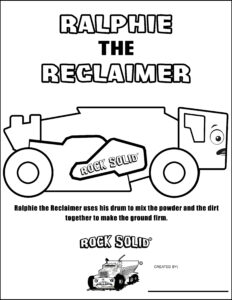
It is never too early to show interest in construction. From digging in the sandbox, building with legos, even driving a toy truck around the house, construction can be a big part of a child’s life.
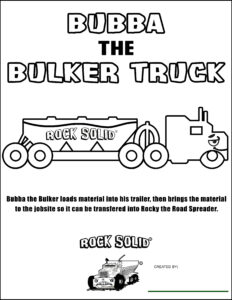
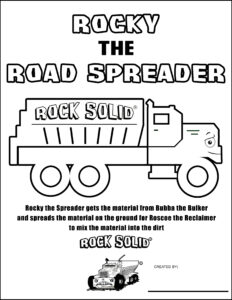
Below you will see several coloring pages (we will be adding new pages daily) to introduce your children to Rock Solid machines!
Click on the pictures, download them, print them, and break out the crayons. Once your child (or even you) are done coloring them, send the finished masterpiece back to us at photos@rocksolidsr.com and we will be sure to post them throughout our various social media sites!